


ENVIRONMENTAL MANAGEMENT AND PRACTICES
Although the companies in EcoRodovias Group follow corporate management guidelines related to the environment, each has the autonomy to implement measures intended at a consumption in line with their reality in developing actions. Concession rules, environmental legislation, internal policies and standards for quality, health, safety and environment are the main drivers of their actions. In addition, the companies' committees on sustainability operates under the supervision of the Sustainability Advisory area.Among the actions carried out by this Advisory area are the seeking of best practices and implementation of internal processes that meet indicators related to sustainability – GRI-G3, GHG Protocol and Ibase Social Balance with NBC-T15 and partnership with the Ethos Institute, in working groups.
In this process, there are differences in the evolutionary stages of the Group's companies, due to the recent integration, operational context and adjustment to new technologies.
It is important to stress the constant search for training employees and stakeholders, in addition to the continuous improvement of processes to minimize the impacts of its operations on the environment.
Basic principles
EcoRodovias intensely dedicates to the preservation and rational use of natural resources in its operations. In addition to always acting in accordance with legislation and environmental requirements, the Company develops awareness and preservation projects such as educational programs for users and neighboring communities, environmental rehabilitation projects and projects involving preservation of regional fauna and flora. Compliance with legislation and continuous improvement of effective control over the generation and disposal of solid waste and effluents, reduced gaseous emissions and noise, transparent communication on issues related to the subject, continuous training of employees, partners and communities are actions that integrate its basic principles, as validated by senior management and spread throughout various hierarchical levels within the Company.
Companies for the Climate (EPC)
GRI 4.12 and SO5Since 2009, EcoRodovias participates in the Brazilian platform of Companies for the Climate (EPC), created by the Center for Sustainability Studies (GVces) of the Getúlio Vargas Foundation, which brings together leading companies to act in the debate on the issue of climate change. This platform supports companies in developing business strategies, corporate policies and systems for management of greenhouse gas (GHG) emissions and proposes an industry regulatory framework for the low-carbon economy in Brazil.
CERTIFICATIONS
As a reflection of efforts to maintain international reference standards of quality in the provision of public services and in actions related to the environment, the Group has recently obtained certifications that attest to this commitment. EcoRodovias is the only one in the world whose concessionaires were granted the ISO 9001 certification for quality and the ISO 14001 certification for environmental management. In 2010, Ecopistas was granted the OHSAS 18001 certification, proving its commitment to occupational safety, hygiene and health. In addition, EcoRodovias deployed the first pavement test laboratory in Brazil accredited by INMETRO with the ISO/IEC 17025 standard.
CONSUMPTION OF MATERIALS
GRI EN1 and EN26The volumes of materials used in the application of asphalt mixtures in the lanes that make up EcoRodovias' highway concessions vary depending on the maintenance work specified in the contractual obligations. The reports to evaluate quality parameters of the paving are prepared in the second half of the year. They verify the segments that need intervention, thus enabling planning for the next year.
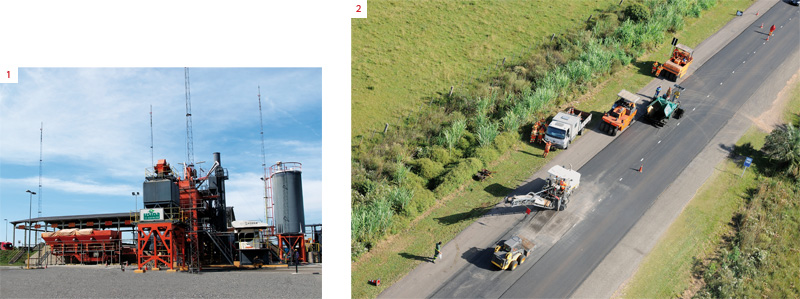
 1 _ Usina de Asfalto2 _ Ecosul_ maintenance
 | MATERIALS USED FOR ASPHALT | 2008 | 2009 | 2010 | ||
|---|---|---|---|---|---|
| Aggregates (m3) | 186,068 | 145,509 | 186,844 | ||
| Binders (such as CM 30, RC 1C, CAP, Ecoflex) (t) | 21,892 | 53,940 | 45,394 | ||
| MATERIALS USED IN TOLL PLAZAS | |||||
| Paper for ticket printing (units) | 76,728 | 123,256 | 187,140 | ||
The chemical trichloroethylene has been acquired by some of the Concessionaires since early 2008 to conduct asphalt mixture quality assurance tests, and will subsequently undergo the process of recycling and reuse.
In addition, to reduce the consumption of natural resources, EcoRodovias uses cold asphalt mixtures with asphalt emulsion, which helps eliminate the heating of materials, reduce the burning of fuel, the consumption of natural aggregate (stone) and the transportation of asphalt materials.
Also, to minimize consumption of materials, the size of the tickets printed at tolls was diminished, resulting in a 46% reduction in paper consumption, and savings of R$0.270 million for EcoRodovias.
ECORODOVIAS HAS EXPANDED
AND ENHANCED ITS MONITORING
OF ENVIRONMENTAL INDICATORS IN ITS CONCESSIONAIRES, ALLOWING
THE DEVELOPMENT OF BETTER MANAGEMENT STRATEGIES.
Materials from recycling
GRI EN2In the Group's companies, the main product used from recycling is the milled material, resulting from maintenance or restoration of paved driving lanes. This material is used mainly in primary coatings for access routes to the main highway and side roads, and destined for the same purpose on public roads, as required by public agencies and municipal governments. Although precarious,
this coating replaces the consumption of mineral aggregate. Recycled paper is also used for EcoRodovias' administrative activities, which contributes to the preservation of natural resources.
Another action in this sense that refers to the use of Polymer – or Rubber Modified Petroleum Asphalt Cement (Modified CAP); the use of this material provides reduction in the consumption of conventional products and mineral aggregates, improving the performance characteristics of the asphalt mixtures used. According to studies conducted by competent organs (DNIT/PR), a 30% reduction is achieved in the thickness of asphalt layers applied to the maintenance or restoration of paved surfaces, resulting in savings of non-renewable raw materials and less disposal of waste.
| MATERIALS USED FROM RECYCLING | 2008 | 2009 | 2010 | ||
|---|---|---|---|---|---|
| Milled material (m3) | 47,433 | 56,848 | 37,798 | ||
| Recycled Paper* (Reams) | 716,847 | 610,554 | 579,203 |
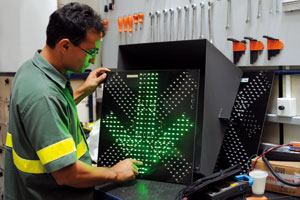 Ecocataratas_ Maintenance
Waste
GRI EN22In 2010, EcoRodovias sought, through its sustainability coordinators, to refine data collection regarding the type, quantity and disposal of waste generated in its Operations and it also sought to equalize the units of measurement in order to enable comparison with other companies in the market.
Although there is a significant difference in the computation of the residues as presented by the Company, there was no increase in its generation, but rather a change in data collection methodology.
| Class I | ||||
| TYPE | QUANTITY | DESTINATION | ||
|---|---|---|---|---|
| Different hazardous wastes (from accidents on the highway and others) | 23.5 t 12.3 m3 |
Controlled landfills properly licensed by environmental agencies |
||
| Fluorescent Lamps | 5,659 units | Co-processing | ||
| Pre-hospital service waste | 3.3 t 11.5 m3 |
Centers for treatment and disposal with the use of autoclave or microwave technology approved in accordance with the region of each business unit | ||
| Class II | ||||
| TYPE | QUANTITY | DESTINATION | ||
|---|---|---|---|---|
| Milled material (m3) | 5,0841.0 m3 | Reincorporation to the procedure or application on the secondary/municipal roads |
||
| Recyclables | 90.0 t | Recycling in companies or cooperatives licensed by competent environmental agencies |
||
| Solid waste from construction | 14.4 t | Reincorporation in the paving process | ||
| Solid waste (tire scraps and pieces of rubber) |
113.6 t | Co-processing | ||
| Solid Organic Waste or non-Recyclables |
852.9 t | Landfills | ||
WATER AND ENERGY CONSUMPTION
Water
GRI EN8, EN10 and EN26The use of water showed an increase in 2010 mainly due to the input of Ecopistas' consumption data and the small increase for Ecosul. Other concessionaires showed reduction as a result of stipulated measures and goals.
Throughout the year, the concessionaires developed awareness campaigns on the use of natural resources, changing standard faucets for timed models, carrying out maintenance to detect and eliminate leaks, and dry washing of vehicles.
The concessionaires are also developing reduction programs with medium and long term results, such as the Ecoefficient SAU. These have set a zero consumption goal for ground water and the goal to re-circulate all of the effluent after treatment in less noble uses, such as cleaning and outdoor gardens. The program is being developed on a pilot basis at Ecosul.
| VOLUME OF WATER USED IN (m3) | CONSOLIDATED | ||||
| SOURCE | 2008 | 2009 | 2010 | ||
|---|---|---|---|---|---|
| Groundwater | 60,697 | 50,243 | 56,266 | ||
| Rainwater | 4 | 28 | 57 | ||
| Municipal/State supply | 9,332 | 11,758 | 16,329 | ||
| TOTAL | 70,033 | 62,029 | 72,651 | ||
Energy
GRI EN3, EN4, EN5, EN7 and EN26The Integrated Management Policy and the ISO 14001 certification guide the Company in its effort improve processes and reduced the use of energy sources. Economic aspects are also considered in choosing the best source to be used by the Group's concessionaires.
The actions developed in 2010 include internal and external campaigns for the rational consumption of energy and water, replacement of vehicles and equipment with more efficient models, including the use of bio fuels, development of studies for the use of solar energy and to obtain the best tunnel lighting efficiency, use of LED lamps at the toll plazas, holding of meetings by videoconference and employee transportation by charter bus.
Regarding electrical energy consumption, Ecovia met its 1% reduction goal. At Ecovias, the 2% reduction goal against 2009 was not met; it recorded increase in electricity consumption due to enhancements made in the Headquarters building structure and adequacy of the demand for lighting at the Jardim Casqueiro cloverleaf interchange. The other companies are studying better ways to define the goals.
| CONSOLIDATED CONSUMPTION | ||||||
| 2008 | 2009 | 2010 | ||||
|---|---|---|---|---|---|---|
| Non-Renewable | Natural gas (m3) | 175,589 | 57,748 | 255 | ||
| Diesel oil (Fleet) (l) | 1,047,237 | 1,159,351 | 1,431,462 | |||
| Diesel oil (Generators) (l) | 26,040 | 26,405 | 63,382 | |||
| Electricity (Thermoelectric) (kWh) | 1,240,248 | 1,289,300 | 1,377,192 | |||
| Gasoline (l) | 5,325 | 33,441 | 176,259 | |||
| Renewable | Ethanol (Fleet) (l) | 1,091,046 | 1,197,127 | 1,152,199 | ||
| Electricity (Hydroelectric) (kWh) | 14,151,979 | 13,918,108 | 17,040,824 | |||
EMISSIONS AND EFFLUENTS
Emissions
GRI EN16, EN17 and EN18EcoRodovias uses the GHG Protocol (Greenhouse Gas Protocol) method to calculate its emissions. The chart at the side shows the consolidated figures.
In order to produce the inventory of emissions for 2010, the figures that make up the GHG Protocol tool were monitored. The expectation for 2011 is that emission reduction goals and projects will be drawn up.
The use of ITS's (Intelligent Transportation Systems) for the automatic identification of vehicles (AVI) has proven to be an interesting way of paying the tariff, allowing the user to make payment while the car is in motion, at a recommended speed of 40 km/h.
Studies show that this results in time savings, due to the roughly 60% reduction in the amount of time to pass through the toll plaza. There are also economic benefits, as the system permits a reduction of up to 89% in the required consumption of fuel, which translates into an annual drop in the amount of CO2 emitted of 961.26 tons, taking the following factors into consideration:
» All toll plazas equivalent in terms of extension and topography;
» An average consumption per vehicle of 2.02 km/l;
» The difference between estimated consumption, if the number of vehicles that used the AVI track were to remain equal to that registered in 2009, and the estimated 8.9% increase in the level of usage of the AVI track.
 1 _ Ecovias Imigrantes 2 _ Ecovias Imigrantes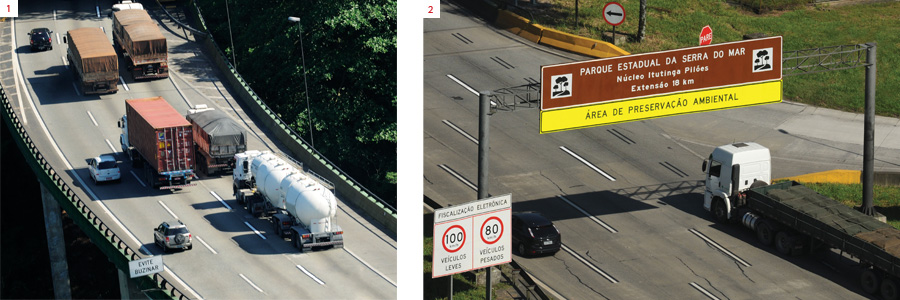
| SCOPE | DESCRIPTION OF THE EMISSION | t CO2 EQUIVALENT |
|
|---|---|---|---|
| Scope 1 | Mobile combustion for transport in general (Company's operating fleet) | 4,196.06 |
|
| Stationary combustion for production of electricity (generators) | |||
| Fugitive emissions from refrigeration and air-conditioning equipment | |||
| Scope 2 | Acquisition of electric and thermal energy consumed by the Company | 966.62 | |
| Scope 3 | Air travel undertaken on the Company's behalf | 1,118.42 | |
| Employees commuting |
Control of cargo spills
GRI EN23EcoRodovias' concessionaires follow the Environmental Management System's guidelines and maintain teams that are prepared to notify the relevant authorities and to deal with emergency cases of spills of hazardous cargo. The table at the side shows the accidents that occurred in 2010.
The concessionaires' goal is to continually train the employees to handle the types of occurrences listed. In addition, they enter into partnerships with entities (such as ABIQUIM) in order to obtain knowledge, carry out simulations and promote awareness campaigns with the trucker-drivers and carriers. In conjunction with the Highway Police and Civil Defense, they conduct frequent inspections on the highways at different locations, days and times.
| HIGHWAY ON WHICH THE SPILL OCCURRED | VOLUME/ QUANTITY OF THE SPILL |
MATERIAL SPILT |
CONTAINMENT ACTION | ||||
|---|---|---|---|---|---|---|---|
| Ecovia | BR 277 | 36,000 liters | Fatty acid methyl ester – Biofuel | Containment barrier, cleaning, remediation and removal of the dregs generated at the site, removal of contaminated river water, special vacuum pump for hovering up the product and storage in a tank for disposal | |||
| Ecosul | BR 392 | Not disclosed | Coal | Collection | |||
| BR 116 | Not disclosed | Fuel Oil | Bung for containment | ||||
| BR 392 | Not disclosed | Gasoline and diesel Oil | "Soy spill" which was collected with diesel oil from the site |
||||
| BR 392 | Not disclosed | Coal | Sawdust and quicklime | ||||
| Ecopistas | SP 070 | 480 liters | Paint | Use of sawdust and sand | |||
| Ecovias | SP 150 | 3,850 | Naphtha | Closure of the highway and collection of the dregs by a specialized company | |||
| SP 150 | 1,500 kg | Ammonium Nitrate | |||||
| SP 150 | 650 liters | Ethyl Acetate | |||||
| SP 150 | 220 liters | Ethyl Alcohol | |||||
| SP 248 | 1,800 liters | Chloric Acid | |||||
| SP 150 | 200 liters | Vinyl Acetate | |||||
| Ecocataratas | BR 277 | 30 tons | Asbestos | The spilt cargo was covered with plastic tarpaulins with the aim of ensuring that users, employees and other people on the site did not inhale the substance. The Fire Brigade was called. The cargo was transshipped for later cleaning of the location and for removal of the contaminated material | |||
| BR 277 | 20 liters | Diesel Oil | A containment dike was constructed to prevent the oil from spreading, and cement was applied to the track and curb in order to absorb the oil, and the contaminated soil was scraped off and collected | ||||
| BR 277 | 80 liters | Diesel Oil |
Biodiversity
GRI EN11The location of the EcoRodovias concessions strongly interact with protected areas, as shown in the following table.
| UNITS | HIGHWAYS THAT CUT THROUGH OR ARE ADJACENT TO LEGALLY PROTECTED AREAS OR AREAS THAT EXHIBIT A HIGH BIODIVERSITY INDEX | GEOGRAPHICAL LOCATION (STATE, MUNICIPALITY) | |
|---|---|---|---|
| ECOVIA | BR 277 | PR – São José dos Pinhais, Morretes; Paranaguá | |
| PR 407 | PR – Paranaguá; Pontal do Paraná | ||
| PR 508 | PR – Paranaguá; Matinhos | ||
| ECOSUL | Not applicable | ||
| ECOPISTAS | SP 070 | SP – São Paulo | |
| SP 070 | SP – Itaquaquecetuba | ||
| SP 070 | SP – Mogi das Cruzes | ||
| SP 070 | SP – Guararema | ||
| SP 070 | SP – São José dos Campos | ||
| SP 070 | SP – Taubaté | ||
| ECOCATARATAS | BR 277 | PR – Santa Tereza do Oeste; Céu Azul | |
| BR 277 | PR – Céu Azul | ||
| BR 277 | PR – Santa Terezinha de Itaipu | ||
| ECOVIAS | SP 150 | SP – São Bernardo do Campo; Cubatão | |
| SP 160 | SP – São Bernardo do Campo; Cubatão; São Vicente | ||
| SP 040 | SP – São Bernardo do Campo | ||
| SP 055 | SP – Santos |
| UNITS | EXTENSION OF THE PART OF THE HIGHWAY THAT CUTS THROUGH OR RUNS CLOSE TO THE PROTECTED AREA (KM) | IDENTIFICATION OF THE PROTECTED AREA | |
|---|---|---|---|
| ECOVIA | 28 km (from km 77 to km 49) (Atlantic Forest, Guaratuba Environmental Protection Area, Rio Pequeno Environmental Protection Area), 40 km (from km 49 to km 09) (Guaratuba Environmental Protection Area, Atlantic Forest, Marumbi Special Tourist Interest Area, Pau Oco State Park) | Atlantic Forest – Marumbi Special Tourist Interest Area, Guaratuba State Environmental Protection Area, Pau Oco State Park and Rio Pequeno State Park | |
| 05 km (from km 00 to km 05) (Palmito State Forest), km 14 (Guaraguaçu Ecological Station) |
Palmito State Forest and Guaraguaçu Ecological Station | ||
| 32 km (Guaratuba State Environmental Protection Area) | Guaratuba State Environmental Protection Area | ||
| ECOSUL | |||
| ECOPISTAS | Cuts the Highway at km 8 | Tietê Ecological Park | |
| At a distance of 1.25 km | Itaquá Ecological Park | ||
| At a distance of 7 km | CEMASI Municipal Park | ||
| At a distance of 6.5 km | Guararema Municipal Park | ||
| At a distance of 1.25 km | Interlagos Municipal Park | ||
| At a distance of 5 km | Senhor do Bonfim Municipal Park | ||
| ECOCATARATAS | Runs alongside the highway for a total of 32 km; Vegetation begins at a distance of 24 meters from the asphalt of the highway |
Iguaçu National Park | |
| Vegetation begins at a distance of 10 meters from the asphalt of the highway | Iguaçu National Park | ||
| Continuous strip that extends beyond the right of way and the BR 277 highway | Santa Maria Biodiversity Corridor (Rio Bonito) | ||
| ECOVIAS | 19 km (from km 34 to km 53) | Serra do Mar State Park – Itutinga Pilões Core | |
| 18 km (from km 40 to km 58) | |||
| 08 km (from km 00 to km 08) | |||
| 01 km (from km 254 to km 255) |