



PERFORMANCE
 |
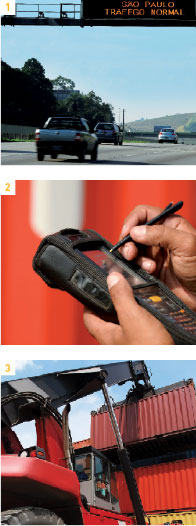
1 _ Ecovias Imigrantes 2 _ Ecopátio Cubatão 3 _ Ecopátio Cubatão |
Chapter 3 of the 2010 Annual and Sustainability Report addresses all issues involved in Grupo EcoRodovias' operational performance throughout the year.
Consolidated traffic totaled 180,051 paying vehicle equivalents, up by 52.2% against the figure of 118,100 paying vehicle equivalents reported in 2009. Revenues from container handling services in Ecopátio Cubatão were based on imports and exports; 61,845 handled containers moved, corresponding to a growth of 301.9% against the previous year.
The Central Highway Security Nucleus worked efficiently to monitor and control targets, evaluating the security statistics for concessionaries, employees and users, and operating in a way that allowed reducing accidents and casualty rates; throughout the year, the Nucleus monitored Active Security indices related to improvements in Brazil's fleet; Passive Security, relating to improvements in highways; and Social Security.
Accident, death, injury and casualty rates were measured on a monthly basis, and involved actions directed to the safety and health of users and the holding of various conferences and campaigns throughout the year about proper behavior on highways.
This Chapter also describes the investments made by the Group in services and operation areas.
Improved corporate processes were implemented in the area of engineering management, which allowed expanding the approach of the area's commitment and performance regarding the Group's companies; a new Engineering Portal was also developed to help the monitoring of units and development of projects, documents and registration processes.
In the Information Technology area, EcoRodovias Group maintained
the investment in technological solutions in order to ensure greater operational efficiency.
The Group's investments were intended to improve pavement and enhance circulation conditions, with due regard for the parameters and obligations provided for in each concession agreement. Highway traffic was monitored based on statistics that were applied for development of new projects. New materials were used in pavement layers, like the addition of rubber tire powder or elastomeric polymer to asphalt, and new solutions for passive safety in highways, such as barriers and impact mitigating elements.
Additionally, general investments were made in highways, such as the application of specific paving techniques – including the addition of rubber tire powder or elastomeric polymer to asphalt, new solutions for passive safety in highways, such as barriers and impact mitigating elements, and landscape.
Moreover, Ecorodovias allocated investments to obligations not provided for in-concession agreements, but required by government authorities since they relate to the importance attributed to safety issues and better mobility conditions.