NET's main activity is its subscriber pay-TV service offering programming packages with Brazilian and international content for culture, sport, news, films and entertainment for all age groups. In addition, NET provides programs sold separately using the Pay-Per-View system and à la carte channels. Pay-Per-View programs are mainly soccer championship packages and even individual soccer matches are sold. The à la carte channels offer more adult or ethnic content and are billed over and above the monthly subscriber charge. These separate services are increasingly gaining importance in NET activities and year by year are showing sustained growth in sales, thus adding value to revenues. [for more details... - go to TV subscriber products]
Vírtua is the brand name for the broadband Internet product provided by NET Serviços, and is increasingly gaining ground with more significant growth in its subscriber base each quarter. Vírtua is now offered in 12 cities (São Paulo, Rio de Janeiro, Porto Alegre, Curitiba, Brasília, Belo Horizonte, Goiânia, Santos, Florianópolis, Campinas, Ribeirão Preto and Sorocaba) and now has almost 200,000 subscribers. [for more details... - go to Vírtua]
Pay-TV
The Brazilian Pay-TV market
The pay-TV industry in Brazil consist of approximately 12 companies. According to the SETA survey conducted in September 2004, there were some 3.7 million subscribers in the country as a whole. These companies operate through three different pay-TV systems: Cable, DTH and MMDS.
The September 2004 SETA survey also found that Cable TV led the market
in numbers of subscribers with 59% of the total, followed by DTH with
35% and MMDS with 6%. NET is the largest pay-TV company in Brazil, with
approximately 38% of the total number of subscribers, and more than 60%
of Cable TV subscribers.
The different types of pay-TV services available in Brazil are described
below.
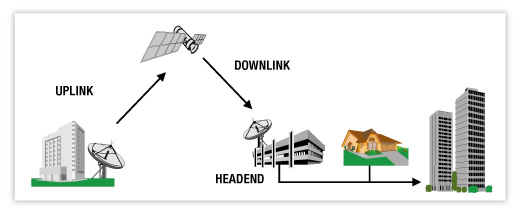
Cable - This is the most frequently used system in Brazil.
Broadcasts are transmitted by the programmers' satellite to the cable
TV operator's headend and on to subscribers through optic and coax cable
networks. Although the investment required is higher than for other systems,
cable TV allows use of the network for other services associated with
pay- TV, such as broadband Internet, conventional telephony and Voice
(Voip). Cable has other advantages: additional connections can be installed
easily and there is no shadow problem of the type found with DTH and MMDS.
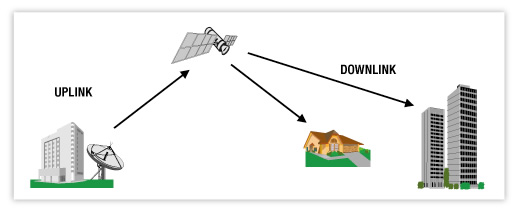
DTH (Direct To Home) - DTH uses medium and high power satellites to transmit signals to antennas installed in homes, hotels and other buildings. Unlike MMDS signals, which are transmitted locally, a DTH satellite may transmit to large geographical areas. Ku band DTH technology provides a larger number of channels, and better image quality compared with C-band technology that has now been replaced in 100% of all DTH services in Brazil.
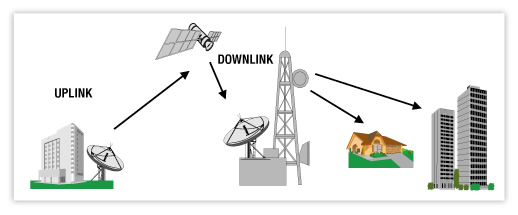
MMDS - This is a special service using microwaves to transmit signals received at certain points within the service provider area. Installing MMDS technology requires less investment than a cable network or DTH transmission. This lower initial cost may represent a competitive advantage for MMDS operators in the pay-TV market. However, this advantage is not applicable in areas with high demographic density, because MMDS usually requires an unobstructed line of sight to transmit microwaves. MMDS also has the disadvantage of limited capacity for extra channels, as well as low signal quality and reliability.
NET Subscribers Profile
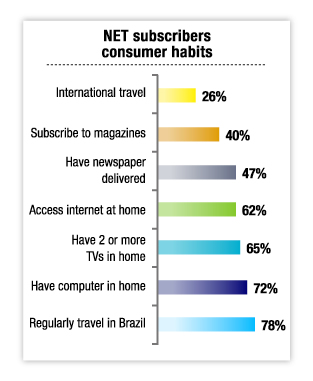
NET subscribers feature a socioeconomic profile with high levels of purchasing
power. They are predominantly classes A or B, according to market surveys
conducted in recent years.
Most have high levels of education. Some 53% have university or college
degrees, and 8% of these have postgraduate or master's degrees. The subscriber
base is also well-connected to the world: 52% of customers speak a second
language and another 72% have a computer at home, while 62% have access
to the Internet in their residence.
The great majority are concentrated in the five largest cities in Brazil
(São Paulo, Rio de Janeiro, Porto Alegre, Belo Horizonte and Brasília),
and generally speaking they do not change providers or cancel the service,
since more than 50% of NET customers have been subscribers for over 5
years.