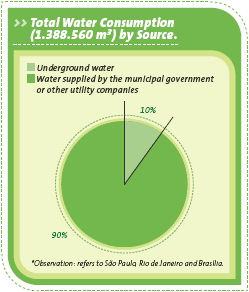
Environmental Performance
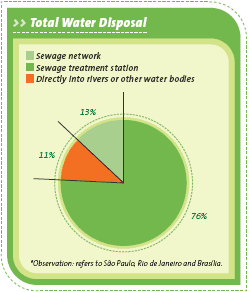
 It is worth noting that 89% of the water reused by the Group is sent to the Effluent Treatment Stations of the state concessionaires and the remaining 11% is directly released into rivers and other water bodies. It is worth noting that 89% of the water reused by the Group is sent to the Effluent Treatment Stations of the state concessionaires and the remaining 11% is directly released into rivers and other water bodies.Energy [EN3 e 4] In Grupo Pão de Açúcar’s energy matrix, the consumption of energy from renewable sources (43.4 x 10¹³ joules or 120,113,133 kWh) is equivalent to 26%, or more than a quarter of total expenses. Another important point is that this portion of energy from renewable sources is acquired in the free market, which favors sustainability in several ways as it strengthens the production of alternative energy, reduces the environmental impact of electricity consumption and does not overload the country’s electricity transmission systems. A small portion of total energy consumption relates to diesel as fuel (direct energy), equivalent to 54 x 10¹² joules or 15,000,000 kWh. Diesel is used only during peak consumption periods, which represents a small part of the stores’ working hours. Grupo Pão de Açúcar considers this an operating weakness and has studied possible measures to solve this issue. As for indirect energy, the consumption of energy from non-renewable sources totals 166 x 166.10¹³ joules, equivalent to 460,297,153 kWh, considering all the units in operation. Emissions [EN19] 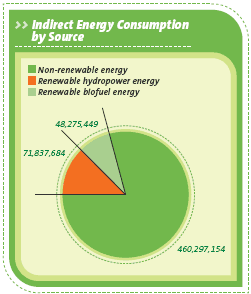 Grupo Pão de Açúcar’s cooling systems (cold chambers, air-conditioners, refrigerators and freezers) use R22, a cooling gas that is less prejudicial to the ozone layer than R-12. In 2008, 117,254 kilos of this gas were consumed. Grupo Pão de Açúcar’s cooling systems (cold chambers, air-conditioners, refrigerators and freezers) use R22, a cooling gas that is less prejudicial to the ozone layer than R-12. In 2008, 117,254 kilos of this gas were consumed.At the Indaiatuba Green Store, inaugurated in June last year, the airconditioning system uses the R-410 gas and the cooling system uses the R-404 gas. These two gases have a negligible effect on the ozone layer and are a new trend in cooling and air-conditioning systems. In order to further contribute to sustainability and increase its own efficiency, the Company set up teams to monitor possible leaks in cooling systems. Dubbed ‘Caça Vazamentos’ (Leakbusters), this program, launched in 2008, uses electronic equipment that detects leaks more accurately with minimum interference on the facilities. Other Areas Grupo Pão de Açúcar seeks to rationalize resources and implement measures to mitigate its impacts, including: Waste Generation: the company has conducted a study on the waste generated by its stores in order to identify environment-friendly ways of disposal by focusing on the concept of 3 Rs: reduce, reuse and recycle. Based on this premise, the Group has adopted initiatives aimed at optimizing the reuse of organic and recyclable garbage, thereby reducing the volume of material disposed of in landfills.. The study conducted by the company resulted in the implementation of a highly successful system at the Green Store in Indaiatuba (SP), whose garbage disposal volume was close to zero. The same system is being adapted at the Group’s stores in Curitiba (PR) and will be extended to the units in other regions. Use of materials: replacement of existing equipment with more efficient equipment or introduction of new technologies, especially lamps, compressors and airconditioning systems. Grease Trap: Application of a natural biological product for the degradation of the organic compounds present. Recycling Stations (SO1) Grupo Pão de Açúcar was the first retailer to offer its customers an alternative for disposing of recyclable materials. The initiative began in 2001 with the installation of Recycling Stations at the Pão de Açúcar chain in partnership with Unilever, which contributed to the program’s rapid execution and expansion. The Recycling Stations have two main aims: preserving the environment and generating jobs and income for the member cooperatives. 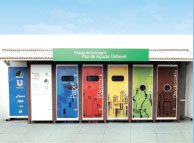 Given the customer adhesion and its own benefi ts, the program was extended to 20 more stores in 2008, totaling 102 Pão de Açúcar Unilever stations. The project is currently one of the most successful recycling programs run by private initiative in Brazil and is well recognized by the community where it is present, growing every year. Given the customer adhesion and its own benefi ts, the program was extended to 20 more stores in 2008, totaling 102 Pão de Açúcar Unilever stations. The project is currently one of the most successful recycling programs run by private initiative in Brazil and is well recognized by the community where it is present, growing every year.The Extra chain also joined the cause last year and, in partnership with Pepsico, created the Extra H2O! Recycling Stations Program. The Group already has more than 140 collection stations, having collected over 26,000 tonnes of recyclable waste, including metal, paper, plastic, glass and cooking oil, generating income for over 20 cooperatives in Brazil. Cooking Oil Recycling For two years, the Pão de Açúcar chain has been receiving used cooking oil. Implemented in 87 stores, this program collects 10,000 liters of oil every month, which is transformed into biofuels instead of contaminating rivers and springs. Last year, following the success at Pão de Açúcar, the project was implemented in ten CompreBem stores. All the collected material is donated to cooperatives and sold to biofuel producers. Caixa Verde (Green Box) 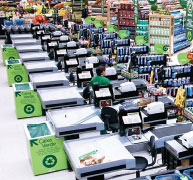 Caixa Verde is the first pre-consumption recycling project in the retail sector. Based on a master’s degree thesis at the Positivo University in Curitiba, this initiative was adopted by the Pão de Açúcar chain to disseminate the concepts of conscious consumption and the importance of recycling. Caixa Verde is the first pre-consumption recycling project in the retail sector. Based on a master’s degree thesis at the Positivo University in Curitiba, this initiative was adopted by the Pão de Açúcar chain to disseminate the concepts of conscious consumption and the importance of recycling.Caixa Verde is a box attached to checkout stations in a few Pão de Açúcar stores where consumers can dispose of packaging they do not intend to take home. Pão de Açúcar collects these papers, plastic and metal scraps and sends them for recycling, generating jobs and income for the cooperatives receiving them. Since its implementation in January 2008, the project has collected more than 60,000 packaging units. Caixa Verde is present in 20 Pão de Açúcar stores in Curitiba, Rio de Janeiro, Indaiatuba, Bauru and São Paulo and will be expanded to the Extra chain and other Pão de Açúcar units in 2009. Returnable Bags Grupo Pão de Açúcar was the first retailer to encourage the use of returnable bags, with the objective of reducing the impact of plastic bag use. In 2005, the Pão de Açúcar chain teamed up with Fundação SOS Mata Atlântica and designed several returnable bags featuring endangered Brazilian species. In 2008, the chain launched new models, totaling 12 different options, sold at accessible prices, to cater to diverse consumer profiles.  All the bags are produced from recyclable materials, including PET bottle plastic fibers. Each bag can replace up to eight plastic bags.
In 2008, the project was extended to the CompreBem chain, which sold 100,000 returnable bags in the launch month alone. More than 430,000 units have been sold so far, with 323,000 sold in 2008 alone. Loja Verde (EN5, 6, 18 e 26) (Green Store) 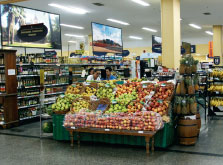 In June 2008, Grupo Pão de Açúcar opened Latin America’s first “Green Supermarket”. The construction of this unit, located in Indaiatuba (SP), considered environmental standards with the objective of having the least possible impact on the environment, pursuant to the criteria for certification by LEED (Leadership in Energy and Environmental Design), which attests to the sustainability of buildings. In June 2008, Grupo Pão de Açúcar opened Latin America’s first “Green Supermarket”. The construction of this unit, located in Indaiatuba (SP), considered environmental standards with the objective of having the least possible impact on the environment, pursuant to the criteria for certification by LEED (Leadership in Energy and Environmental Design), which attests to the sustainability of buildings.With an investment of R$7.5 million, Loja Verde employs technologies that allow 10% energy savings compared to a regular store of the same size. In addition, 100% of the energy used in the store comes from renewable sources, which represents a reduction of 34,000 tonnes/year in carbon emissions, equivalent to the reforestation of over 190,000 trees. If these trees were planted, they would occupy an area of 580,000 m², which is larger than the entire city of Indaiatuba, which spans 310,564 km². 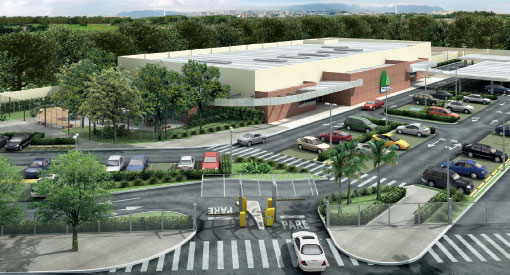 The modern air-conditioning system consumes 10% less energy than a traditional system, equivalent to savings of 120,000 kWh per year. Regarding water resources, savings is guaranteed by the installation of special taps and valves that reduce water consumption by 40% in relation to a traditional Grupo Pão de Açúcar store, saving 2,52,000 m3 per year. Water heating for showers in the locker rooms uses the surplus heat from the engine room, generating savings of 48,000 kW/h in this area alone. In addition to the construction, Loja Verde also features other measures implemented in other Group stores, including Caixa Verde, incentives for the use of returnable bags and a large supply of organic products. Extra Itaim Gas Station Grupo Pão de Açúcar has 74 gas stations distributed as follows: 5 in Pão de Açúcar, 15 in CompreBem, 45 in Extra, 1 Extra Fácil and 8 Sendas/ABC CompreBem. All gas stations offer hydrated ethanol and regular and unleaded gasoline. In addition, a few units also offer premium gasoline, diesel and NGV (natural vehicle gas). The fuels sold by the Company’s brands come from digital pumps and state of the art – eco-friendly – licensed and certified equipment, with extremely competitive prices and superior quality. In addition to the quality of its fuels, the Company is already operating a pilot project for the recovery of the gases emitted in the transfer of gasoline while filling both the gas stations and vehicle tanks, considerably reducing the impact of the operation on the environment. The system, in operation at the Extra gas station in Itaim, in São Paulo, is the first of its kind in Latin America and consists of the installation of an exclusive recovery system for gas waste. In operation since March 2007, the project allows the collection and recovery of vapors, called volatile organic compounds (VOCs), which are traditionally eliminated during discharging fuel and filling vehicle tanks. In order to make it possible to capture these gases, Extra installed specific equipment that sucks gas during the entire transfer process before releasing it into the atmosphere. The Company invested over R$160,000 to adapt the discharge system, pumping nozzles and hoses that collect vapors and transfer them to the truck. The latter then takes the gas back to the distributor so that the material is processed and transformed into liquid fuel. With this pioneering system, an estimated 1,200 kilos of gas fuel are prevented from being released into the environment every month. Environment-related Penalties [EN28] Grupo Pão de Açúcar has specific departments that are responsible for obtaining all the necessary licenses, whether for operating stores or for selling products. Occasionally, fines are levied on the company, which may appeal against them based on facts. In most cases, its legal appeal results in cancellation of the penalties, since there is normally a legal deadline for the authorities to grant the licenses. In case of fines relating to sales of products and services, Grupo Pão de Açúcar transfers them to the suppliers because in such cases the company is only a seller and not the manufacturer/producer responsible for obtaining the necessary certification. It must be highlighted that all agreements for the provision and supply of services involving Grupo Pão de Açúcar hold the supplier of products and services wholly responsible for the fines levied on the Group for irregularities noticed by the public authorities. Grupo Pão de Açúcar’s commitment to the quality and excellence of services, as well as to the sustainability best practices have always been recognized by diverse entities. In 2008, the Group received various awards and honors, which are listed below: |